4 Kasım 2012 Pazar

"The Beat Goes On" at Dillard's

To contact us Click HERE

Here’s a set of vintage snapshot photos I purchased severalmonths back. Taken in Austin, Texas in April 1967, they depict famed pop stars Sonnyand Cher on a bandstand in front of a Dillard’s department store. The photosare a bit overlit and fuzzy (not unusual for outdoor shots from an inexpensiveKodak 126 Instamatic – like millions of others in those days, most of mychildhood photos were taken on this exact type of camera), but you can tellthat Sonny and Cher seem to be having a good time and the crowd is excited.  
When I first saw these photos I was intrigued, and twoquestions came to mind: What brought these entertainers, L.A. denizens to thecore, to Texas? And what prompted a personal appearance at Dillard’s, thenamong the smallest specks on America’s department store landscape? (We’ll getto that in a minute.) Through a bit of research I found a satisfactory answerto first question and reached a fairly obvious conclusion about the second.
It turns out that Sonny and Cher were in town for a moviepremiere. On April 11, 1967, the world premiere for the movie “Good Times”, thefirst picture to feature the couple in starring roles, was held in Austin. The premierewas part of a weeklong promotional Texas trek that, according to an April 29Billboard magazine article, included stops in Dallas, Fort Worth, Houston,Abilene and El Paso. (“A cowboy’s work is never done”, they say.) My guess is afashion show at Dillard’s was added at some point to the duo’s itinerary.
The “rock and roll movie” was a fixture of American cultureby 1967, and if an artist had a few hits under their belt (Sonny and Cher hadscored a number one smash with “I Got You Babe” in 1965, one of five Top 20 hitsfor the pair in just a little over a year), some personality and a unique presence(Cher’s dusky voice and exotic looks, Sonny’s fur vests and bowl haircut), amovie offer was usually a solid bet. These movies varied wildly in quality, andmore often than not were “star vehicles” with minimal, hackneyed plots. “GoodTimes” featured the rock and roll singers in a movie about…well, rock and roll singers becoming movie stars. (Viewing it today, it’s a fun, much better thanaverage sixties romp. And the styles were incredible, topped off by GeorgeBarris-designed his-and-her Mustangs specially built for the film. Long clipscan be found on YouTube, but you didn’t read that here!)
History shows that 1967 was the start of a long dry spellfor Sonny and Cher. “Good Times” bombed at the box office, and “The Beat GoesOn”, a number 6 pop hit, would provide the Bonos’ last Billboard chart actionfor a very long time. So they headed for Las Vegas. Only made it out toNeedles. There, they found steady work as a casino act, and over the nextfew years they carefully honed their stage personas (personae?) – Sonny, thenaïve, somewhat air-headed dreamer, and Cher, his quick-witted, sharp-tonguedwife, always ready to burst his bubble with the perfectly timed wisecrack.
Audiences loved it, and in 1971 CBS came forward with anoffer for an hour-long summer replacement series. “The Sonny and Cher ComedyHour” quickly became a national sensation, a Top 10 show for several seasons ina row, and a weekly fixture of millions of TV viewers’ homes, mine included.
When the couple announced their divorce in 1974, it was apalpable shock. Their lives took very different courses over the ensuingdecades, with Sonny eventually entering Republican politics, winning the officeof Mayor of Palm Springs, California then a seat as a U.S. congressman. In1998, he died in a tragic skiing accident. Cher, no last name necessary,remains an entertainment icon, with at least number one hit in each decadesince her first emergence on the scene. I still think of her 1999 hit “Believe”as “the inescapable song”, because unless you stayed in your house all yearwith a supply of food, windows and doors duct-taped shut and the lights turnedoff, you couldn’t escape it. We took a family vacation to California that yearand heard it at least once every 15 minutes, including while standing in linefor the mine train at Calico. Somehow it made perfect sense.
All right. Lest you think this site has turned into “RetroEntertainment Tonight”, I figure it’s about time I said something about that statelystructure behind our Hollywood heroes. That, my friends, is the first “real”Dillard’s store, which opened in February 1964 in Austin’s Hancock Shopping Center.
It was a far cry from the first store opened by William T.Dillard in Nashville, Arkansas, a rural town southwest of Hot Springs, in thelate 1930’s. Born in 1914, Dillard grew up in the tiny town of Mineral Springs,Arkansas, where his father owned a dry goods store. His early years weretypified by hard work at the family store and a desire to learn the retailingbusiness inside and out, the quintessential American story of a young mandiligently following in his father’s footsteps.
By his mid-twenties, however, Dillard had earned adistinction that set him apart from most American young men of the day,certainly those from rural Arkansas. In 1938, he earned a masters’ degree inbusiness from New York’s prestigious Columbia University, where he attended ona scholarship.  Valuable as a Columbiaeducation was, however, Dillard’s exposure to the Big Apple’s legendarydepartment stores – Macy’s, Gimbels and John Wanamaker (Dillard worked at theirManhattan branch while in school there) – arguably did as much to shape hisfuture career.  
Leaving New York, Dillard pursued management trainee jobswith Sears, Roebuck and Co. and J.C. Penney, and received offers from both. Penneyoffered Dillard positions in Walla Walla, Washington, of all places, and themuch closer to home Topeka, Kansas. Dillard took Sears’ offer, which was closerstill –a Tulsa, Oklahoma store. He stayed there only seven months beforeleaving to open his own store, in Nashville, Arkansas, as mentioned.
The store did well, but over time Dillard grew restless. Mostof all, he was eager to avoid his father’s mistake of “wast(ing) many of hisabilities because he was confined to a small town”, according to author LeonJoseph Rosenfeld in his brief but excellent 1988 book “Dillard’s: The FirstFifty Years”. In 1948, Dillard purchased a 40 percent in Wooten’s departmentstore in Texarkana, -- miles to the southwest on the Texas border, a muchlarger market with a population of 55,000. The following year, he bought theremaining interest in the Texarkana store (by then called “Wooten &Dillard”) and sold off the Nashville business.  Within five years it became the leading storein Texarkana, and Dillard, who had relocated his family there, was one thearea’s prominent citizens.
Interestingly, Dillard reversed course in a sense when hebought back into a small market with the March 1955 purchase of adepartment  store in Magnolia, Arkansasfrom a friend. It was back to bigger things the following year, however, whenthe opportunity arose to acquire a well-respected East Texas  department store. For years, Dillard hadadmired Mayer & Schmidt, the leading store in Tyler, Texas, a town with apopulation similar to that of Texarkana.
Mayer & Schmidt, founded in 1899, was a well run storewith a fine reputation, drawing customers from a radius well beyond the city ofTyler. In 1956, however, they were in trouble. The previous year, Mayer &Schmidt opened a second store in town “to capitalize on its prosperity”, but thenew location turned out to be a flop, and “within a year it was closed anddeeply in debt”, according to Rosenberg. Based on his success in Texarkana,Dillard was able to line up financing, and in April 1956, acquired a majoritystake in the Mayer & Schmidt store. Dillard immediately embarked on acomplete remodeling and expansion of the store, adding furniture, appliance,jewelry, records and hi-fi departments along with leased shoe, book and fur operations.The revamped Mayer & Schmidt debuted on September 17, 1956, and would proveto be a great success under Dillard’s ownership.
In 1959, a banker friend of Dillard’s informed him of anotherwell-regarded department store recently befallen by rocky times. Brown-Dunkin Companywas Tulsa, Oklahoma’s largest department store (more than twice as large anenterprise as Mayer & Schmidt), founded in 1924 by brothers-in-law John H.Dunkin and John A. Brown, and “occup(ied) the first nine floors of thefifteen-story Hunt building at Fourth and Main streets, the city’s busiestcorner”, Rosenberg states, and “had become a household word in northeastOklahoma”.    
Brown-Dunkin’s problem was one of succession. Dunkin hadpassed away in 1958 and Brown some years before that, and the store went intodecline under the management left in place by the founders’ widows. Intrigued bythe challenge of running a well-known store and the chance “to prove hisabilities before a national audience” as Rosenberg put it, Dillard set off onan arduous seven-month process of negotiations with the Brown and Dunkin widowsand numerous banks. Ultimately, he was required to put up the Mayer &Schmidt store as security for the transaction. Knowing he could fall back onthe Texarkana and Magnolia stores should things go awry, Dillard pressedforward confidently. On the last day of February 1960, Dillard took control ofthe Brown-Dunkin store.
Initially there were headaches – after the ownership changewas publicized, picketers from the local Building Services Union showed up onthe sidewalks outside the Brown-Dunkin store. Unbeknownst to Dillard, theprevious ownership had recently dismissed the store’s cleaning ladies and elevatoroperators, contracting out those functions to outside firms. Dillard refused toreopen the issue and eventually the picketing stopped. Then there was thematter of $150,000 worth of unpaid invoices discovered in a drawer, whichforced Dillard to obtain an additional line of credit.
On top of these hassles was one more that ended up turninginto a considerable plus. In sharp contrast to today, mid-20th century America was dotted with department store companies that ranged in sizefrom single-store outfits to 20-plus-unit multi-regional chains, with mostfalling somewhere in between. To increase their negotiating power with clothingmanufacturers and other suppliers, many department store firms signed up with(usually New York-based) buying cooperative agencies. These agencies strove torepresent one department store chain in each major city, while doing their bestto avoid any competitive overlap between clients. When Brown-Dunkin’s buyingagency, Mutual, caught wind of the buyout, they figured Dillard wasn’t capableof pulling the potatoes out of the proverbial fire and dumped Brown-Dunkin infavor of Vandever’s, another Tulsa department store.
Not long afterward, Dillard joined up with the FrederickAtkins Company, “one of the more prestigious buying houses in the country”, asRosenberg put it. The Atkins firm represented a host of marquee names includingJohn Wanamaker (Philadelphia), B. Altman (New York), Hochschild-Kohn(Baltimore), Miller & Rhoads (Richmond), Ivey’s (the Carolinas and Florida), Pizitz(awesomely-named, Birmingham), Chas. A. Stevens (Chicago – did you really thinkI’d leave that out?) and The Broadway (of latent “Mad Men” fame, Los Angeles),among many others. When he signed on with Atkins in 1962, Dillard was theirsmallest client. By the early 1980’s, he was their largest.
Two years on and these problems behind him, Dillard waseager to expand.  Dillard had “recognizedthe shift of the population to the suburbs and the need to provide stores closeto them” as far back as his brief tenure with Sears, Rosenberg noted, and he“had wanted to open a unit in a mall for some time to see if it would work”.  For this exciting new venture he partneredwith Homart, a recently created mall development subsidiary of Sears, thenferociously active in the Southwest. Dillard initially considered Homart’s first mall project, the just openedSeminary South Shopping Center in Fort Worth, Texas. (Many years later, in1987, Dillard finally put in a store there.) Also in the running was Homart’s still-in-developmentCoronado Center in Albuquerque.
Instead, he chose a third Homart project, the HancockShopping Center, to be located in Austin and co-anchored, of course, by Sears(second photo here). Dillard’s methodology behind this choice was novel, to putit mildly. From Rosenberg’s book: “Dillard had been visiting in the city(Austin) and was waiting for his flight to Albuquerque when he happened tothumb through a telephone book. He noticed there were more Lutheran churches inAustin than any other denomination and associated the churches with Germans,who had always impressed him with their work ethic and honesty. On that basis,he decided that Austin would be an excellent place for his store.”  (And here I always thought the Methodistswere the benchmark for retail site selection. Shows you what I know.)
Obviously the Lutherans and a great many others likedDillard’s store. It was an unqualified success, resetting the template for allof the company’s future growth. From that point forward, Dillard “took everyopportunity in subsequent years to co-anchor new malls with Sears or Penney’s”,Rosenberg wrote, “…he was not in direct competition with either store, and theyboth made good mall partners for him”.
Importantly, the store was the first to carry Dillard’s ownname, not counting his early dry goods stores in southwest Arkansas. (As a sidenote, Dillard sold the Texarkana and Magnolia stores in 1962 to Aldens, aChicago-based catalog retailer then seeking a piece of the brick-and-mortarside of the business. Aldens had recently bought out Shoppers World, and woulditself be absorbed by Gamble-Skogmo in 1964.) Although he would continue to puthis own name on stores in markets that were new to the company (Austin, forexample), for years he maintained the names of acquired companies in theirrespective markets, such as Mayer & Schmidt and Brown-Dunkin, even whenadding new mall-based stores in their areas.
As mentioned, the Austin, Texas Dillard’s store opened inFebruary 1964. Later that year saw the return of Dillard and his family (fromTulsa) to Arkansas, this time to Little Rock, the state capital, where he had recentlyassembled a considerable retail enterprise. Over the previous year, Dillardbought out the Gus Blass Company and Pfiefer’s, two of the three largestdepartment stores in the area, the other being M.M. Cohn. The buyouts werecarried out with the help of funds from the Mayer & Schmidt stockholdersand $1.5 million kicked in from Sperry & Hutchinson, who invested on thecondition that Dillard hand out their S&H Green Stamps in his stores. BothBlass and Pfeifer’s were large downtown stores with one branch apiece – Blassin Pine Bluff and Pfeifer’s in Hot Springs. In 1965 a mall-based Blass storewas opened at Park Plaza in Little Rock, and two years after that, another atthe then new (and just recently torn down, except for Sears) Indian Mall inJonesboro. Starting in 1967, Dillard’s Little Rock-based operations werecombined under the name of Pfeifer-Blass, although I don’t know for surewhether this change was extended to store signage.    
The late 60’s and early 70’s were a furious period of growthfor Dillard’s companies, and virtually all of it took place at the malls. 1965saw a Brown-Dunkin store at Southland Shopping Mall in Tulsa, followed byanother at the Northland Shopping center the following year. In Oklahoma City,he opened a “Dillard’s Brown-Dunkin” store at the Sheppard Mall, “a first stepin phasing in his own name for all his stores”, according to Rosenberg’s book.In 1968, two Dillard’s stores were opened in San Antonio, at Central Park Malland what is now known as South Park Mall. And the growth continued from there –the first Missouri location, at Springfield’s Battlefield Mall was added in1970, as was the first Louisiana location at Shreveport’s Shreve City Center.
In 1974, the various Dillard-controlled stores all took onthe “Dillard’s” name, reflecting the incorporation of Dillard’s enterprisesunder one financial umbrella. More importantly, it provided a consistent brandimage for marketing purposes. While many (including me) lament the passing ofso many great department store nameplates in recent decades, it has proven to bean unstoppable, irreversible trend.  It’sinteresting to note, however, that even Macy’s, the proverbial poster child”for department store rebranding, owned Davison’s (Atlanta) for 61 years beforeconverting them to Macy’s in 1986 and Bamberger’s (“New Jersey’s greateststore, and one of America’s finest”) for 57 years before finally hanging the red star onits front door that same year. 
When William T. Dillard passed away at age 87 in 2002, hisnamesake company that began so humbly was America’s third largest departmentstore chain, according to his New York Times obituary. Today, among “luxury” departmentstores (i.e.: not including Sears, Kohl’s and J.C. Penney), they remain numberthree, behind Macy’s and Nordstrom and ahead of Neiman Marcus and Belk, perStores Magazine’s latest rankings. Today, Dillard’s boasts over 300 stores in acoast-to-coast empire. And the beat goes on.
Below, a 1972 newspaper ad hailing the new Dillard’s storeat the Northwest Arkansas Plaza, as reproduced in the Rosenberg book - anenjoyable hodgepodge of names and architectural styles if there ever was one.

Bring Back the San Fernando Penney's!

To contact us Click HERE

You know, there must be some people who read this siteregularly and wonder – “Dave, you’re a blogger. Why don’t you ever take a standon anything? You never weigh in on the big issues of our time. You’re always onthe fence. Asleep at the wheel. Out to lunch. AWOL!”
Well, friends, I want you to know that I hear you, and todayI’m answering the call! And the issue I herewith weigh in on is one that is, orshould be, near and dear to our classic retail-loving hearts. It can be summedup in one phrase:
Bring back the San Fernando J.C. Penney.
When a national retail chain closes shop in a long-standinglocation, it’s typically news – in the local area, that is, and not far outsideit. But this summer, when J.C. Penney ended an 80-year tenure in San Fernando,California (the city of San Fernando, specifically, which lies within the SanFernando Valley, part of Greater L.A.), it set off a furor that popped in andout of national headlines for weeks.
On Saturday, July 28th, despite rallies in thelocal community, online petitions, celebrity pleas, tons of local news storiesand national coverage from the likes of the Huffington Post, the public radioshow Marketplace, Bloomberg Businessweek (Plain old “Business Week” was muchmore concise, right? But hey, it’s his magazine now!) among others, J.C. Penneyshuttered the San Fernando store, which had existed in its current locationsince February 1953.
Official comment from JCP on the matter has been terse,putting it charitably. “We would not have moved forward with this difficultdecision if we did not believe it was absolutely necessary for the futuregrowth of our company”, the company’s press response read.
Speculations behind the closing have been raised (and shotdown) from several angles, with some alleging the closing was part of an effortto trim costs in light of huge losses JCP has experienced this year as aconsequence of its controversial rebranding/repositioning efforts.  Others contend the small store (60,000 squarefeet with just over half of that space devoted to selling, three floors, noescalators), long an anomaly for Penney, is a poor fit for the rebrandingconcept. Still others claim the San Fernando location itself has beenunprofitable for years.
It’s easy to understand why San Fernando residents are upsetabout losing their Penney store, an obvious point of pride for the community.The store has been an anchor for their downtown at a time when most big-nameretailers long ago abandoned downtown locations for the “wide open spaces” werefer to today as malls and shopping centers. Certainly it was handy – whilePenney has no shortage of huge stores in The Valley, it’s hard to beat “downthe block” for convenience, even though selections were limited compared tostandard Penney stores. There’s the longevity factor – the San Fernandolocation far outlasted the hundreds of downtown Penney stores built through thedecades up until the late 50’s. Indeed, had JCP opted to close it down in 1970or 1980, the uproar might never have materialized.
Lastly, the store’s timeless deco-influenced facades, frontand rear, remain a thing of beauty. Most late 1940’s/early 1950’s Penney storesacross the country were very plain in appearance, while the San Fernando unitexemplifies the extra effort that many national retailers poured into theirCalifornia locations. Just two years ago, the building’s owner, AshkenazyDevelopment, spent some $350,000, including the services of a historian, torestore the facades and the “Penney’s” blade sign, which reportedly hadn’tworked for nearly forty years. 
The story took a nasty turn on the second night after thestore’s closing, when residents discovered sign crews (after dark, with the companyname on their truck covered up) pulling the “J.C. Penney Co.” lettering off theback of the building and one worker preparing to go after the neon blade signwith a torch, all in violation of an order to leave them alone pending ahistorical preservation hearing. The removed letters were reinstalled the nextday.
At this late date, it seems unlikely that J.C. Penney willreopen the store, but you have to admit it would be a great public relations gestureand would serve to counteract some of the negative publicity the company hasreceived in recent months. The “Save San Fernando’s JCPenney” site features acouple of interesting concepts for expansion, should JCP reverse theirdecision. At any rate, the store’s designation as a historic site appears to beassured. Rightfully so.
Our goal here, of course, is to depict great stores likethis in their heyday, and once again I thank the J.C. Penney Archives at theDeGolyer Library at Southern Methodist University for their invaluablecooperation in supplying these photos – festooned in Grand Opening glory, followedby an interior view, then front and rear facade views from after thefestivities cooled down.
As a postscript, here’s a sidenote from the “Basic DataSheet”, a centrally-maintained dossier of sorts, for this store, last updatedin 1971 and now part of the JCP archives. It’s interesting to note who Penney’s regarded as competition in thosedays -within a four-mile radius, there were department stores: Ohrbach’s, TheBroadway, Robinson’s, a small Sears “hard-lines” store, discounters White Front,Kmart, Gemco and Cal Stores (sister division of Baza’r stores). “Fantastic Fair”one of my ultra-faves, is also listed, but I’m pretty sure they were gone bythat time. (I’ll have to do a 10-part series on that one someday.)There were alsothe variety stores Grants and Newberrys, and apparel stores Scotts, the Melody Shopand Sally Dresses. The Penney’s unit outlasted them all.

Tuckerton Cub Scout's 1949 Minstrel Show

To contact us Click HERE
I've posted a couple of Blog entries on New Gretna Minstrel Shows over the past few years. Minstrel shows were popular from the late 1920's through the mid 1950's in our area. Last Friday, at the monthly New Gretna Friendly Seniors meeting, Pat Steinhauer surprised me with a photo and program booklet of a 1949 Minstrel Show staged by the Tuckerton Boy Scouts, Pack 7, in the Tuckerton High School auditorium which I thought I would share with you. Her husband, Gerry, is at the far right in the second row.
Two other boys who appeared in the photo, Sam Leifried and Russell Mathis, were particularly interesting to me, as I see them frequently on Wednesdays at the Tuckerton Historical Society. 
I wonder if anyone out in the Blog-O-Sphere knows any of the other boys in the photo. If so, I'd like to hear from you.
Pete S
Click on the photo above
and the pages below for a clearer view.


New Gretna's Rt. 9 Mansion

To contact us Click HERE
Not a month goes by that I don't get 3 or 4 emails asking me for information on the Rt. 9 walled mansion that is constantly evolving with a collection of interesting statues and sayings painted on the wall. 

Unfortunately, I didn't know much more than the inquisitive emailers. That is until my men's breakfast buddy, Carl Joorman, a former New Gretna resident presently living at the Four Seasons at Harbor Bay in Little Egg Harbor, gave me a copy of the Harbor Bay Breeze, a monthly newsletter published by the adult community.

The July, 2012 edition of the Breeze contained an article and photos of the New Gretna mansion. It seems that John Ways and Arnold Scharfstein, who collaborate on a monthly story and photo column, were getting repeated questions from Harbor Bay residents concerning the mansion. The dynamic duo decided that a story on the mansion was in order.

I met John and Arnold the other day for lunch to get the skinny on how they got their story and photos. They graciously shared their adventure at the mansion with me. 

One day they decided to stop at the mansion and take photos of the statuary. As Arnold was poking the telephoto lens of his Nikon through the iron gate, Adalid Gomez, the caretaker of the property, walked up to them and asked what they were doing. After hearing their explanation, he invited them onto the property and introduced them to the property's owner, Byung Taek Kim.

Mr. Kim proved a friendly, hospitable host and took John and Arnold on a tour of the property. The following story and photos evolved from that tour.


The Wonderful Homestead on Route 9Written by John Ways. Photos by Arnold Scharfstein.
Many of youhave driven up or down Route 9 on your way to or from the Garden State Parkway and you saw an amazing sight. Nearmile marker 58.5, you probably saw dinosaurs on a long wall with canons on eachpillar and super hero transformer action figures in front of its gates. Mr.Byung Taek Kim, owner of this 60 acre homestead, was very kind to invite Arnoldand myself into his facility for a walking tour along with Adalid Gomez, hisproperty caretaker.
The author, John Ways, standing by the steam engineat one of the gates to the property


We learned that this property wasonce a farm owned by Benjamin Franklin Headley in the mid to late 1800's andlater owned by the Bush family. Then in 1970 it was purchased by Eddie Sims ofBrigantine who decided to restore the farmhouse and enjoy the property for hisown use. It seems that Eddie owned some worthless bay property in Brigantinewhich Harrah's Casino decided to buy. With his new found wealth, Eddiepurchased the farm and started renovations in 1970.
The property was abandoned some 15years ago so Mr. Kim, of Fort Lee, NJ, purchased it in September of 2010 to provide a funsummer home for his family. Mr. Kim, Chairman of the Taekwondo Association ofGreater New York said that "He purchased the property for the soleenjoyment of himself and his family and not for any commercial venture."For the past year, Mr. Kim has been renovating and remodeling the buildings,redoing the landscaping, and adding many new features that add to the fun natureof the property. He said it would probably take another year or soto complete all of the renovations and additions that he has in mind; he willkeep his gates closed until completion.
Byung Taek Kim
Our tour started in the rear of thehouse on the north side where we saw a large raised, covered wooden dog runapproximately 100 feet for a collie and a German shepherd. It included a largedog bed with brass header and footer and other amenities for the dogs. On ourright was an amazing 75 foot replica of the famed Korean Turtle Ship builtby Admiral Yi Sun-sin during the Japanese invasion of Korea in 1592 and used successfully todefeat the Japanese Navy. It features a dragon head, iron plating, guns on allsides, and spikes on the curved upper deck to prevent the Japanese fromboarding it.
Turtle Ship
A little farther toward the rear weentered a large enclosed area that included numerous chickens. Although thechickens were roaming outdoors, there were two new large hen houses with glassdoors and a pond within this enclosure. We think the chickens were of theAraucanas or Ameraucanas breeds because they were laying blue eggs. Our laststop at the rear of the property was a lake with clear blue water, a dock witha ladder and a large covered but open cabana with seating facing the lake.Although this lake was stocked with bass, there were others stocked withgoldfish and koi.
On the north side of the propertywas the barn which housed Batman, ablack stallion who had a large fenced in pasture in which to run and play. Mr.Kim enjoys riding and he rides Batman around the property on his riding path.
Batman
Near the mainhouse, which has completed renovations, is a large swimming pool with a woodenbridge spanning across the middle of it. On one side of the pool is a threestory castle-like building with place for pool furniture storage and otheritems. Along the side of this structure is a waterfall that straddles the leftside of the structure. On the top are two bright metallic knights and inbetween is an elephant head.


The three story main house on thesouth side of the property was built in three phases and has been renovated toMr. Kim's specifications. Around the back there are various sculptures sittingatop the pillars of the rear fence. On one side is a vegetable garden; on theother a fully lighted tennis court. In front of the house is a bright reddragon accompanied by two stone angels. On one side is a 20 foot giraffe alongwith four smaller ones.


In front ofthe house and in its garage are 400 year old sculptures including pagodas,Buddhas in stone and brass, and Christian sculptures of Christ and angels, 15foot black stallions, and colored dragons that are awaiting placement. Thesesculptures come from Korea, Texas and local South Jersey artists.


Arnold and I thoroughly enjoyed ourtour and are so grateful for Mr. Kim's hospitality.
Reprinted with permission from the Harbor Bay Breeze.
I hear various opinions from local residents regarding Mr. Kim's whimsical endeavor. As for me, I think he is a welcomed addition to our community. I always smile when I pass the mansion, and I look forward to what the future might bring.

Well, that's the scoop on the mansion. Perhaps, now, I won't be getting any more email inquiries.
Pete S
PS- Click on the photo of the mansion below to read a previous Blog post that provides some background information on the mansion property.


Following are a few photos that I took today.


The Old Tuckerton Water Tower

To contact us Click HERE
The August 30, 2012 Blog featured a 1890's photograph (below) of a horse drawn railroad side car with a barn and windmill in the background.
Click on the above photo to go to the 8/30/12 Blog Entry.
The windmill in the photo was the subject a few comments: 
I was just looking at the 1895 Sanborn fire insurance map for Tuckerton and see a windmill noted behind the bank (now Tuckerton Liquors) and the funeral home. There are still concrete piers there that may have been associated with the windmill. Perhaps this is the windmill in the photo? German Georgieff
Great idea to look at the Sanborn Fire Insurance maps for Tuckerton; however, I don't think the windmill behind the bank is the same windmill that is in the photo. P Stemmer 
The concrete piers behind the old bank/funeral home are the base of the old TUCKERTON water tower, seen in many old town pictures. Arnold Cramer
My good history buddy, Shirley Whealton, tells me that the concrete foundation at the rear of the old bank, now a liquor store on Rt 9, is from an old water tower, not a windmill. P Stemmer
It is obvious from the comments that the windmill in the photo is not linked to the concrete foundations behind the old Tuckerton Bank Building as suggested by German Georgieff.
The old Tuckerton Bank on Rt 9 is now a liquor store.
Arnold Cramer and Shirley Whealton correctly pointed out the the concrete foundations are remnants of the old Tuckerton Water Company tower. These foundations, which look like a miniature Stonehenge, can be clearly seen in the following aerial photo.
Map courtesy of Bing Maps
Seeing the old water tower foundations got me thinking about the origins of the Tuckerton Water Company and when the tower was built. I asked some Tuckerton old timers if they knew when the water tower was built, but no one seemed to know. It's not surprising, as there are no eye witnesses of the tower being built, as I discovered, while reading some Tuckerton Beacon "Out of the Past" news articles, that it was constructed in 1898.
A series of brief Tuckerton Beacon articles chronicles the formation of the Tuckerton Water Company and the building of the tower.
The Tuckerton Water Company was granted a franchise in 1898 with the condition that it would provide 5 free fire hydrants throughout the town.

The 45,670 gallon water tank was completed by the Tippet & Wood of Phillipsburg, N.J. at the end of June, 1898

The water for the tower was obtained from the headwaters of Lake Pohatcong to ensure that the water was pure.

Half price specials were offered to induce new subscribers to hook up to the newly available water service. It sounds a lot like today's advertising.

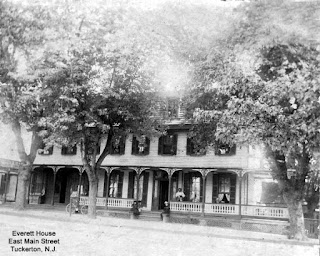
The Everett House, a popular hotel on Tuckerton's Main Street, was the first to connect to the new water system.
Photo courtesy of the Tuckerton Historical Society.
The services of the new water company were so popular that plumbers were in high demand. Not having air conditioning, it seems a cool bath in the hot summer hit the spot with many residents.

Common stock was issued to raise capital for the start up costs of the water company. The stock certificates list the official name of the company as the Tuckerton Water Works Co.


The total value of the stock issued in 1898 was $12,000.00. Adjusted for inflation, that value would be about $320,000 today. That is a very modest sum to start up a water company today.


Following are a few postcards, from the Tuckerton Historical Society's collection, showing views of Tuckerton taken from the water tower. If you recognize any of the buildings or can estimate when the photos were taken, let's hear from you!


Notice the outhouses lined up like soldiers behind a group of houses and Lake Pohatcong in the background in the following postcard.


Lake Pohatcong can also be seen in the view below.


Unfortunately, I haven't been able to locate a photo of the water tower, nor do I know when it was dismantled. If anyone out in the Blog-O-Sphere can help me with these issues, I would appreciate hearing from you.
Pete S

13 Ekim 2012 Cumartesi

Christmas "On The Square" at S. Klein!

To contact us Click HERE
So to speak, that is. Regardless of location, S. Klein stores were always “on the square”, even if they were in a mall, a shopping center, or the middle of a field. It was an integral part of the name, dating back to the opening of their famous flagship store on New York City’s Union Square. An engineering square (barely visible below the “L” in the sign) served as a company logo of sorts for years.

Founded in 1906 as a wholesale manufacturer of women’s garments by Samuel Klein, a tailor’s son who emigrated from Russia at the age of five, S. Klein on the Square had evolved into a “full line” store by the early 60’s. They staked out the rarefied territory between department store and discounter, in a similar vein to E.J. Korvette and Alexander’s. Although Klein would eventually carry everything from furniture to food, the emphasis remained on fashion, for women in particular. In 1966, they were acquired by McCrory Corporation, assuming the role of high-end counterpart to McCrory’s Lerner Shops division and their growing stable of variety stores. Sadly, Klein was another in a long list of 70’s recession casualties, gradually closing stores in the early part of the decade and gone altogether by its end.

But times were good when the photo above, showing the Woodbridge, New Jersey location in one of its first Christmas selling seasons, was taken. This store opened on November 11, 1963 (a few weeks after the opening of a lookalike Klein unit in Greenbelt, Maryland), causing “jammed traffic for more than three miles in both directions on Route 1”, with some customers walking a half mile to the store, the next day’s New York Times stated. At a massive 360,000 square feet with parking for 4,000 cars, the Woodbridge store was Klein’s top selling location by 1970.

A little snow would have made this the perfect scene, but I’ll bet that parking lot was a bear as it was!

It's a Wonderful Life at Penney's

To contact us Click HERE
Christmas in downtown Lancaster, Pennsylvania, sometime in the late 40’s or early 50’s. The charming Santa decoration says both “Merry Christmas” and “Season’s Greetings”, so everyone is covered. Colorful garland hangs across the storefronts on either side. The building itself easily dates to the earliest years of the 1900’s if not before, and undoubtedly housed other businesses prior to J.C. Penney’s tenure.

Looking at this, I just know that Lancaster must have been home to a gracious soul like George Bailey, protecting the town's virtue and helping people in need so they didn’t have to “go crawling to Potter” or whoever the local robber baron may have been.

A good thing, too - otherwise the neon sign here would have read “Dime a Dance” instead of “Penney’s”!